Recipe: TWELVE-Hour Turkey

My turkey recipe is very, very simple.  I start with the largest turkey I can find and I stuff it with as much stuffing as I can possibly get into the bird (inside the body cavity as well as under the skin wherever possible).  I do all this the night before Thanksgiving and then my husband (Thank GOD for that man) gets up at 3:30AM to put the stuffed bird into a 200-degree oven and we allow it to cook all day.  NOTE:  I do, at some point, have to turn the oven off and turn it right back on again because apparently there’s a fail-safe on my oven that doesn’t allow for the oven to remain on continuously for 12 hours.  At the end of the 12 hours, remove the turkey from the oven and allow it to sit on a carving tray for 10 minutes (tented with foil) while you make the gravy and give the meat time to rest and for the juices to redistribute.  Once you carve the meat off the bone, place on a tray and, if you’re not eating immediately, pat with bits of margarine, seal with foil, and set on the stove top to keep warm.

Here’s photos of my turkey, from stuffed to cooked:

I know this recipe is going to freak a lot of people out, but I felt compelled to share my turkey recipe with you all here on my wine blog.  While this recipe doesn’t traditionally use wine, you can easily add some to your stuffing liquid.  I’d suggest using the same wine (my preference is an Oaked Chardonnay)  that you use for much of your meal, for consistency’s sake.  NO need to baste – basting decreases the oven temperature every time you open the door and dries out your bird.

Extra Note:  I stuff my turkey before going to bed, put the turkey in the fridge, then it’s put into the oven at 4AM to begin the cooking process.  I have been told that this is not safe, but have never had a problem with it in any way.  You are more than welcome to decide to stuff or not to stuff your turkey, depending on your comfort level.  I also do not baste or brine the bird.  We haven’t found this to be helpful and it really does save a step.  I typically cook a 20+ pound bird and the meat is always juicy and flavorful, although I’ve made as small as a 12# bird and as big as a 28# bird.

I was given this basic recipe from Dawna, a woman at our church in Michigan who owned/operated a restaurant in the area and generously made a Thanksgiving dinner for the entire congregation each year.  Amazingly, this was the way she was able to bake so many turkeys for a noon meal for such a large crowd.  She shared this recipe with me before we moved to Virginia in 2000.

I keep the turkey in the oven and increase the heat to 350-degrees for the last 45 minutes to begin cooking the remainder of the meal.  See sample time table below:

Sample Time table for Thanksgiving Dinner at 4PMFeel free to adjust timetable for your dinner time.

  • 3:30AM: put turkey in the oven at 200-degrees – I don’t pre-heat the oven
  • Before Noon: make peas, sweet potato pie, prep potatoes
  • 1PM: start rolls, start making mashed potatoes
  • 2:45PM: form the rolls (roll into cloverleaf shapes, three dough balls per muffin cup)
  • 3:05PM: Oven goes to 350 degrees, peas go into oven (40 minutes) **This is usually when I turn off the oven and turn it back on again.
  • 3:15PM: pan stuffing into oven (30 minutes)
  • 3:30PM: sweet potato pie goes in (15 minutes), warm up the turnip casserole in the microwave (7-9 minutes) take turkey out of oven and put bird on platter (let bird sit for a good 5 minutes before beginning to carve, then cover platter with foil) *start gravy (I start gravy first so I’m not carving the bird too early)
  • 3:45PM: all out of oven – raise temp to 400 degrees and put rolls in to bake (15 minutes)
  • 4:00PM: Time to EAT!

This may be a rather unconventional way of making your Thanksgiving meal, but it’s become our favorite.  I’ve roasted a turkey in a paper bag slathered with butter… I’ve cooked the bird on a rack with veggies around it… I’ve followed the “4-hour turkey” recipe… in all cases, this recipe has surpassed all our expectations and resulted in a picture-perfect turkey, suitable for any special occasion or holiday meal.  For a photo of this ginormous bird, check out my Stuffing recipe… it shows you the turkey in more stages than I could here!

I wish each and every one of you a most blessed holiday season and thank you for your readership and participation in this blog.  Happy Holidays!

Recipe: Chardonnay Cran-Blueberry Sauce

“It’s the most wonderful time of the year…”  That’s what Thanksgiving is, in our family.  This is my most favorite holiday… the one dedicated to giving thanks for each and every blessing, for spending time with family and friends, and for sharing lots of wonderful food.  There’s no expectation of gifts or presents… it’s all about the presence

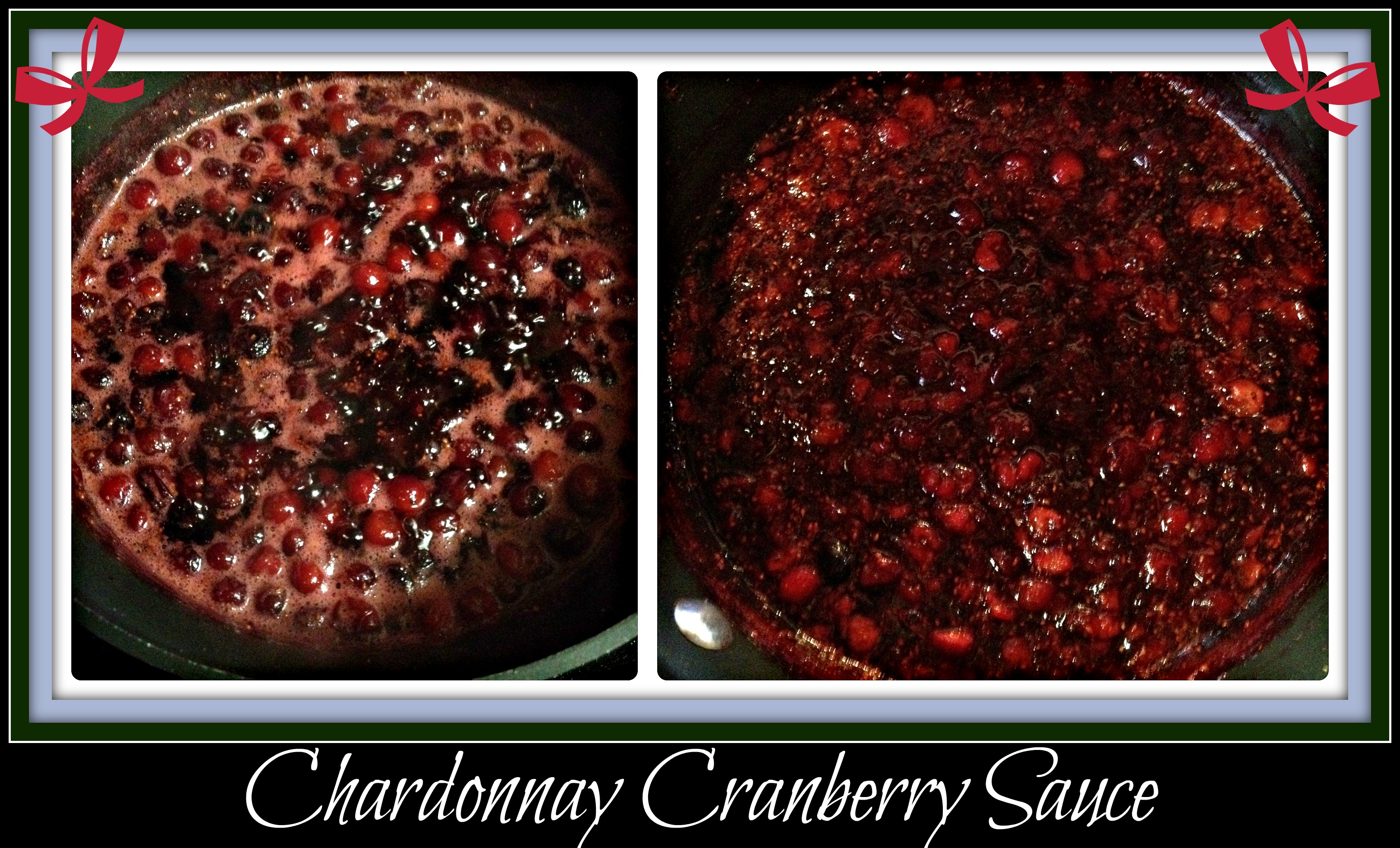
As we start this week of the Thanksgiving holiday, I start cooking in stages.  I’ve already cut up half of the bread for my holiday stuffing, made a loaf of “stuffing bread” (a simple italian bread recipe to which I add poultry seasonings and herbs) and will brown up the sage sausage that goes into my stuffing later this afternoon.  I’m making as many things ahead of time as I can, so that my holiday won’t be entirely spent in the kitchen and away from my family.  While I could just as easily have opened a can of cranberry sauce, this recipe is one that I started making last year and found it to be a wonderful addition to our holiday meal.  It’s my Chardonnay Cranberry Sauce.  Jelled and chilled (this recipe really does need to have time to sit in the fridge), this sauce can be used on sandwiches just as easily as it compliments a turkey dinner…. and it’s sooo much better than something out of a can!ChardonnayCranberrySauce

I start with a bag of cranberries and pour them into a saucepan. Remove a half cup of the cranberries and chop these fine and set aside for a bit.  This year I added a half cup of blueberries to the cranberries, just for a little variety and a touch of sweetness.  To the berry mixture, I added 1 cup sugar, 1 cup James River Cellars Reserve Chardonnay, some orange zest, a dash of nutmeg, a little salt and a bit of lemon juice.  I set the heat to medium and simmered the mixture until the berries popped and the sauce began to thicken.  I tend to get a bit impatient, waiting for the berries to all pop, so I like to use a potato masher to squish anything that hasn’t popped.

Once the sauce is nicely thickened, add in the reserved chopped cranberries and stir to combine.  You’re not heating these berry pieces through, so remove the sauce from the heat and allow it to cool before transferring it to a container and popping it into the fridge.  This can be made a few days ahead of time, but you’ll want to use this within a week (if it lasts that long) after the holiday.

Enjoy this yummy cranberry sauce… it’s become one of my favorite parts of our Thanksgiving and Christmas dinners!

Recipe: Chicken Chardonel Cassoulet

I truly love having an afternoon when I have time to make a hearty, warming, delicious dinner.  I love to start with a few ingredients and turn them into something that just screams “Fall” to me and my family.  This was just such a meal. I make a lot of cassoulets, but this one turned out really well… so well that I wish I had doubled the recipe so I could have it for another few meals.

Tradition dictates that a “Cassoulet” is a French dish made with meat and beans.  It’s actually named after the slanted-side earthenware bowl (called a Cassolein which it is to be cooked.  I don’t own such a cooking vessel, so I use a large heavy stockpot that will stand up to some good old-fashioned cooking.  I don’t subscribe to the notion that you have to purchase a ton of different individual utensils to make a good meal.  It’s not necessarily about the final presentation… it’s about the care and love that goes into anything you make.  I realize that this can sound pretty hokey, but it’s honestly how I approach cooking in general.

This recipe was fairly simple and came together extremely well.  I used the following ingredients:  olive oil, one package of boneless, skinless chicken thighs, one thin slice of ham steak (thinly diced),  2 cans of cannellini beans (I used one can of pinto beans and one can of cannellini beans, because that’s what I had on hand), well-chopped Mirepoix (a mixture of carrots, celery, and onion…. don’t let the “big word” bother you), 2 bay leaves, salt/pepper, a can of chicken broth, a can of James River Cellars’ Chardonel, 2 Tablespoons of pumpkin puree, and 1/4 cup of non-fat plain Greek yogurt.

NOTE:  As you may know (if you read this blog at all), I cook using “The Force”.  I look at my fridge and pantry when cooking and adjust my ingredients based on what I have available or what might look good to me at any given moment.  This was one of those recipes.  If you’re starting with a recipe (especially one of *my* recipes), feel free to add or subtract ingredients to tailor the meal to your family’s taste preference or pantry contents.ChickenChardonelCassoulet

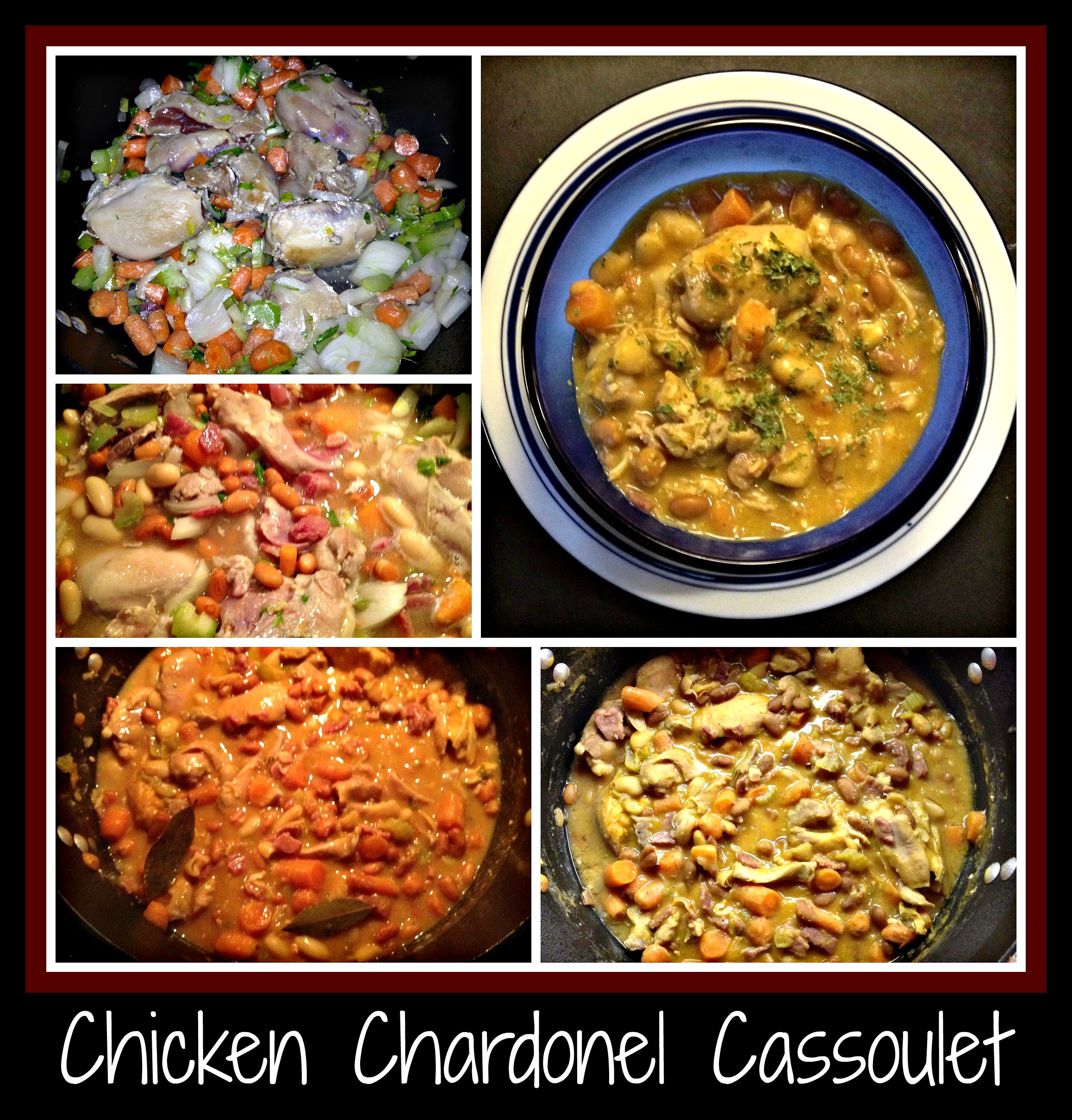
I started with a heavy, rounded stockpot.  I added some olive oil and sauteed the diced ham until it was fairly crispy and the fat had rendered out of the ham.  Using a slotted spoon, I removed the ham and added the mirepoix to saute and soften for a few minutes before popping in the chicken thighs and allowing them to brown a bit.  The meat is going to cook for an hour or two, so don’t worry about whether it’s browned long enough… you simply want the color on the meat before adding in the rest of the ingredients.  Once the chicken and veggies were sauteed (see top left hand photo), I replaced the ham into this mixture and started layering everything into the pot.

The middle photo on the left shows the cassoulet after I added the can of pinto beans (WITH liquid), can of cannellini beans (WITH liquid), can of white wine (James River Cellars’ Chardonel), can of broth, and seasonings.  I put the lid on the pot and allowed everything to cook together for an hour before starting to adjust seasonings.

The bottom photos show the cassoulet after I added a bit of pumpkin puree.  I realize that this is a strange ingredient to add to a cassoulet, but (as I keep saying) it was in my fridge and I knew that this small amount would thicken the sauce a bit without changing the flavor significantly.  I could have made a roux (butter and flour) and slowly added it to thicken the sauce, but I really felt that would have thickened the cassoulet too much.  It’s really up to you as to how you thicken (or not thicken) your meal… that’s the glory that *is* cooking… make it your own!  My final addition was a huge spoonful (about 1/4 cup) of non-fat plain Greek yogurt.  I could easily have used sour cream, but I try to always have Greek yogurt on hand for just such an occasion.   I absolutely could have left the yogurt out at this point, but adding that light touch really finished the cassoulet and made it special.

That’s a cassoulet, in a nutshell.  Not too hard, right?  This recipe is something that can provide you and your family with a filling, one-pot meal that only needs some crusty bread on the side to complete your dinner.  I hope you’ll try your hand at making this recipe… and making it your own… you may even find a new family favorite!


How to make a sauce… and a bonus recipe

Have you ever been frustrated when trying to make a sauce (or even a simple gravy) for dinner?  Here’s a basic sauce recipe that you can personalize to fit any meal… and it’s easy!  I’m also including a mash-up of step-by-step photos so you get a feel for how each stage should look… hopefully that will help as you create your own masterpiece.

Start with butter, olive oil, and flour.  I typically will start with a 1:1 ratio of fat to flour, so if I’m using one tablespoon of butter and one tablespoon of oil, I’ll use 2 tablespoons of flour.  Note:  Much of this is driven by the amount of sauce you want to make, so if you’re hoping for a large amount of sauce for a casserole, feel free to double these amounts.   Saute’ your fat/flour in a pan until it’s bubbling and gets just a slight bit “toasty” looking… you’re making a simple roux to start this sauce.  (This is the first photo I’ve included in the upper left corner.)

SauceBasics

Once you’ve given the flour some time to cook, you’ll begin adding your liquids.  I like start by adding wine first.  I use whichever wine I feel will go nicely with the end product.  I used James River Cellars’ Montpelier (a Cabernet Franc “Blanc”, if you will) and thought it paired well with the cheese I was using.  (The second photo, below the first shot)  Feel free to use red wine if you’re making a sauce for something heartier than chicken or fish.  I always use a whisk and make sure to thoroughly incorporate the liquid into the sauce at each point before moving on to the next.  How much wine you add is entirely up to you.  I like to add about a cup at the beginning (use your morning coffee cup if you’d rather not get another thing dirty).  Whisk the wine into the sauce and as it starts to tighten up, you’ll begin to recognize when to add more liquid.

After adding wine, I like to then add stock to my sauce.  I try to always have some chicken stock (or broth) in the fridge but feel free to use whatever flavor you feel will best fit the rest of the meal.  When taking the photos for this post, I was making a sauce for my Chicken Divan casserole, so I used chicken stock.  If I were making a sauce to top a steak or piece of beef, I would have used beef stock.  Try to always keep your final product in mind while making segments of a meal so that everything coordinates nicely.

At this point, you’ve got a lovely, smooth gravy.  Add some Worchestershire sauce, liquid smoke, or a dash of Liquid Aminos and you’ll have a great way to bring some pizzazz to your meal.  Since I was making a sauce for a casserole, I needed more “heft” to this sauce and decided to add 4oz of grated cheese.  I used a Monetary Jack cheese to pair with the Montpelier wine I used earlier, but sharp cheddar would pair nicely with a big red wine and a mild colby or creamy goat cheese can accent the crisp taste of a bright Chardonnay or Vidal Blanc.  Choose your favorite and make the sauce your own!

Once the cheese is incorporated, and the sauce is smooth and creamy, add your spices at the last moment.  Again, I was making a Chicken Divan, so I chose to add a palmful of curry powder and some dried parsley.  This is another opportunity to personalize your sauce and make it taste the way *you* want.   Allow the sauce to cook for a moment, whisking as you go, and use it however you like.  In this case, I poured the sauce over a casserole of chicken and broccoli – it was the perfect piece to pull all the flavors together.  YUM!

Now, I *DID* promise you a “bonus recipe”… here it is:  Buttered Bread Crumbs!

ButteredBreadCrumbs

I’ll admit that “Buttered Bread Crumbs” doesn’t sound like much of a bonus, but if you’ve never made this wonderful topping for a casserole, you have no idea what you’re missing.

I reused the pan in which I had just made the curry sauce and warmed some olive oil, butter, garlic, and salt.  I simmered this mixture a bit while I cubed up four potato rolls that I had on hand.  I have made this using chiabatta bread… homemade bread… leftover rolls… I’ve even used a few slices of a simple white bread.  Use what you have on hand… this is a topping and meant to be a way to use leftover loaves of bread.  No matter what you use, it’s a really tasty addition.

Once your butter mixture is warm and your bread is cubed, add the two together and toss them over medium heat until they pick up some crispy edges.  They don’t have to be entirely cooked… they’ll toast up in the oven after you put them on top of the casserole.  NOTE: If you’re making bread crumbs for a salad, you *will* want to toast them long enough to get them crispy on all sides.

Simple, right?  I adore this bread crumb topping… it’s something from my childhood that brings back wonderful memories of comfort foods and family meals.  I hope you enjoy trying this topping for your family casseroles!

Helpful hint:  If you’re reheating a casserole, you can add some fresh buttered bread crumbs to the top and toast it in the oven before serving… no one will guess that you’re serving leftovers!

Enjoy!

Recipe: Chardonnay Pesto Shrimp & Pasta

I started planning dinner before I left for work this morning.  I didn’t do anything as adventurous as get out the crock pot and start dinner… nope….  I just started thinking about what I wanted to make that evening.  Such is my life when I get to talk about wine all day.  Mind you, I’m definitely not complaining… just making an observation.  When I lead guests through a wine tasting at James River Cellars Winery, I gloss over recipe ideas and offer up ways to use the various wines we have to offer.  It’s the way I’ve always done wine tastings, but apparently it’s unique enough that people are stunned when I toss out recipe after recipe for our wines.  Thankfully, the winery owners have allowed my blog to be linked to the winery’s website, Facebook page, and Twitter account – guess I’m doing something right, huh?

I stopped off at the local grocery store to pick up a bag of shrimp on my wayChardonnayPestoShrimp&Pasta home and grabbed a tube of Pesto paste to use, along with some bow tie pasta.  I thawed, peeled, and sliced  the shrimp in half when I got home so that dinner prep would be as simple as possible.  Then I got out the rest of my ingredients:  a lemon, a pat of butter, olive oil, James River Cellars Winery Chardonnay, and a touch of half & half left over from another meal this week.  Once my husband got home, I was ready to start cooking.

I put some of the bow tie pasta into a pot with some salted water and got that started while I melted butter and olive oil in a large saute pan.  As soon as the butter/oil mixture was hot, I added the shrimp and allowed it to cook thoroughly – I had sliced the shrimp length-wise so the thin shrimp pieces curled up into little corkscrews.  Once the shrimp was cooked, it was time to start creating a sauce.

I made the sauce with the shrimp in the pan.  Sometimes I’ll remove the shrimp, but I was feeling a little lazy tonight and didn’t do this extra step.  I added some wine to the shrimp and let it sizzle for a bit until the chardonnay had almost been absorbed by the shrimp.  I then added the juice of the lemon, some pesto paste, a little more wine, a splash of half & half, and some of the pasta cooking liquid.  I allowed this to simmer until the sauce looked thick enough before I tossed everything with the cooked pasta.  It was quick and delicious!

The entire meal, cooking from start to finish, really only took about 15 minutes.  I even had enough time to defrost and toast a ciabatta roll so we could each have half to soak up the sauce.   While there are tons of different things I could have added or changed about this recipe, the clean taste of the wine, lemon, and shrimp paired with the pasta was just what I was looking for tonight.

I hope you’ll experiment with this recipe and come up with your own favorite version… it’s one of my favorite things to do.  Enjoy!

Recipe: Updated Chicken Prosciutto Roll

I know this is a re-do of a recipe that I posted in August, but honestly this  set of photos is much more informative than the first, so I decided to go ahead and add it… never hurts to show you more about a recipe than less, right?  I also adjusted this recipe a bit from the original, so please forgive my repetition… I want you to have as much info about recipes as I can provide, especially when I make something so tasty that doesn’t actually use a recipe.

I wanted to make a simple, yet elegant, dinner with James River Cellars’ Gewurztraminer wine.  Since we have found that the tastiest pairing of cheese-to-wine uses Bourcin cheese with this particular wine, my primary pairing was already set.  Sadly, though, my local grocery store was out of Bourcin Cheese, so I had to make due with a local goat cheese infused with garlic and herbs which turned out to be very tasty and worked just as well (in my humble opinion).

I started with three large chicken breasts from a sale package of chicken breasts.  Note: I don’t know what sort of giant chickens produced these breasts, but they were thick, meaty, and looked amazing.  I’m sure that they are genetically altered and I should have reached instead for the organic meat, but I was looking for value this time – I was able to get 5 breasts for the price of 2 organic breasts, so that made my decision for me yesterday.  I ran my knife through the meatiest part of the breast but didn’t cut all the way through, so I could open the breast like an envelope and make it as thin and wide as possible.  I used a mallet to pound the thicker spots down a bit so everything was even and got on with the recipe.

Making sure not to tear the meat, I separated a thin slice of prosciutto and laid it on top of the open chicken breast, then topped the breast with a thin line of garlic/herb goat cheese (here’s where I would have used the Bourcin Cheese, had I been able to find it at the store).  Once the layers were in place, I carefully rolled the chicken, beginning at the  side rather than from one of the ends, and then used a long skewer to secure the breast meat and keep all the toppings inside.  My goal was to make a long/thin roll as opposed to a short/fat roll so the meat would be able to cook thoroughly without being too overdone on the outside.  NewChickenPriscuittoRoll

When you are ready to cook dinner,  add a pat of butter and a bit of olive oil to the pan and then sear the rolls on all sides until they are browned and crispy.  I actually made the rolls earlier in the day and let them sit in the fridge until I was ready to cook, but you’re welcome to make them whenever it works for you.  I definitely would have done this earlier in the day if I were making it for company.  Once the meat is seared along all edges, I added the remaining cheese (maybe the last inch of the roll of goat cheese) and Gewurztraminer wine to create a bit of sauce in which the rolls could cook.  Note:  Since I knew the inside of the rolls weren’t anywhere near ready, my plan was to bake them in the oven until my husband came home for dinner.  I’m not sure exactly how long I baked them (remember… I USE THE FORCE TO COOK) but I had set the oven at 350 degrees and popped the saute pan in the oven until things “smelled done” and we were ready to eat.

To finish this dish, I used a bag of green beans and a bag of brown rice.  I microwaved the beans first and tossed them with a little butter and salt before serving.  I microwaved the brown rice afterward and divided that out among the dinner plates.  Removing the skewer at this point wasn’t easy, but I used a fork to keep things steady as I gently pulled the skewer out of each chicken roll.  The final touch was to spoon the cooking sauce over the chicken and rice.  It looked as pretty as it tasted!

Extra idea… if you are serving a small group of people, you could make four of these rolls and then slice them to serve onto individual plates instead of offering each person their own chicken roll.

This is one of my favorite recipes to share with people when I do a wine tasting at James River Cellars.  I do hope that you’ll consider trying this recipe and make it your own.  That’s the essence of cooking… creating something delicious to feed the ones that you love.

Enjoy!

Recipe: Stephanie’s French Toast Bites with Blueberry Wine Sauce

I have to start this recipe by saying that I love breakfast foods.  Eggs Benedict… pancakes… french toast… hash browns… sausage… waffles… bacon… you get the picture.  I could have breakfast-for-dinner at least once a week (although my husband much prefers to limit breakfast foods to “breakfast/brunch time”).  Because of this love affair I have with breakfast, I enjoy creating different sorts of recipes that showcase some of my favorite options, especially when I can incorporate wine into the mix.  The best of both worlds, right?

This recipe was created for my dear friend, Stephanie, who’s having a difficult time eating full-size servings of food these days.  To tempt her into eating breakfast one day, I came up with the idea of having small crouton-size bites of french toast that she could eat with her fingers or dip into a fruity sauce.  It was a big success, so I thought I would share this special recipe with everyone here.  I’ve named this recipe in her honor because without her, I wouldn’t have thought to make this delicious breakfast dish in such a unique manner.

I started by cutting up a few slices of whole wheat bread into bite-sized cubes.  Using my memory, I blended an egg (you can absolutely use egg substitute if you prefer), some milk (I like using almond milk if that’s on hand), some white wine (I used Vidal Blanc last time but use whatever you may have in your fridge… just decrease the amount of sugar if you’re using a sweeter wine), a sprinkling of sugar (as desired), a touch of vanilla, and a dash of cinnamon (to taste).  Using a wire whisk, beat the egg mixture until it’s just becoming frothy.  I wanted something that would taste light, so I opted to whip the mixture until it was light and airy.  I then tossed the bread cubes in the egg mixture until all the cubes were soaked with the egg-y-yumminess.  When you’re ready to cook the toast bites, melt a pat of butter (and a touch of olive oil if you’d like) and transferred the toast bites to a very warm saute pan to cook.  Note: don’t crowd the pan, so feel free to do this in two sections if necessary.  

Stephanie'sFrenchToastBites

In the meantime, using a small saute pan (or sauce pan), melt a pat of butter and add a handful of blueberries,  Feel free to use whatever berries you have on hand or prefer.  We had quarts of blueberries in the fridge, so they were the natural choice when I was creating the sauce to go along with these toast bites.  As the berries begin to warm and pop open, add some red wine (I went around the pan twice with a lovely Pinot Noir… again, because that’s what was in the fridge.  If I’d had a different red wine available, I might have changed to that one instead.  Use what you have and what you enjoy!) sprinkle some sugar to sweeten the sauce, and I decided to add a dash of cinnamon, to mirror the taste from the french toast bites themselves.  Allow the sauce to cook until it reduces and thickens.  If it gets too thick, add a little more wine… if it’s not thick enough, feel free to add a little more sugar.  This is a Use The Force sort of recipe… make it your own!

You’ll notice that there are also some bites of sausage on the serving plate in the photo – we had turkey sausage that needed to be used (and it was a good source of protein), so I browned the sausage until it was crispy and delicious.  It’s not a prerequisite… just another flavor to temp my dear friend into eating more than she had planned.

Sometimes, you’ll find that you need to expand your horizons when it comes to feeding your loved ones.  If someone isn’t feeling particularly well, feel free to play with your recipe to tempt them into eating something tasty and good for them.  It’s not about who’s doing the cooking or even about how they’re cooking… it’s about the love that is conveyed by the simple act of feeding people.

As you cook, may you enjoy the challenge and turn it into an expression of love.  That’s what it’s all about…

Recipe: Healthy Bread Pudding

Ok… I’m probably pushing it by saying this recipe is “healthy”, but it’s certainly got more healthy ingredients included than some of my recipes, so hopefully you’ll forgive this slight.  In any case, I think this bread pudding recipe is fabulous… I’ve made it twice now and it’s only tasted better each time.  If you’re not a huge fan of bread pudding, then feel free to skip this one.  If you like bread pudding at all, this is definitely one to try!

HealthyBreadPudding

This recipe makes a single serving, so if you’re planning to make this for more people, just increase the ingredients as needed.  I made my recipe with the following ingredients:  2 cups of cubed ciabatta bread,1 mini-box of raisins, 1 Tablespoon of chocolate chips (I chopped mine), 1/4 cup fat-free egg substitute, 1/3 cup unsweetened vanilla almond milk, 1/4 cup white wine, 2 teaspoons Chia Seeds, 2 packets of Equal (feel free to use your sweetener of choice), and some cinnamon to taste.  I also sprinkled the pudding with regular sugar just before popping it into the oven.

I started by assembling all my ingredients, pre-heating my oven to 350 degrees, and spraying my baking dish with Pam cooking spray.  Note:  I neglected to spray my baking dish the first time I made this recipe and it took ages (and some serious elbow grease) to get the dish clean.  I put the bread cubes into the baking dish and then mixed the remaining ingredients in a measuring cup.  I then poured the liquid (and the raisins/chips) over the bread and, using my hands, mixed and mashed the liquid into the bread cubes until they were sufficiently soggy (see the lower right photo).

Once the bread was heavy with the egg/milk mixture, I sprinkled a bit of sugar on top and popped the baking dish into the oven for 30-40 minutes or until a knife inserted into the center came out relatively clean.  I let the pudding rest for 10 minutes, til the dish was cool enough to hold, and dug in with a spoon.  It was heavenly, in my opinion, with tiny bits of chocolate and plump raisins found throughout the dish, with a very faint back note from the wine.

This recipe was wonderful and a great example of comfort food to me.   The reason I called it “healthy” was the use of Fat-free Egg Substitute (in place of eggs), Almond Milk (in place of cow’s milk of any sort), along with the use of Chia Seeds (rich in Omega-3 fatty acids) and raisins with a small amount of chocolate.  Even with the wine, this recipe came in under 275 calories, which was a definite plus in my book.  Another plus?  This is a dish that you could serve to company as a dessert, simply by adding a hard sauce or ice cream to top each serving.

I hope you’ll try this recipe out sometime.  Call it whatever you like, it’s simply delicious to me!

Recipe: Summer Crock Pot Roast

I’ve been rattling off the basics of this crock pot dinner to people for about two years now, but always forgot to take photos along the way and didn’t want to post this meal without proof of how yummy it looks.  Forget the taste… this dinner just looks tasty.  Add some crusty bread, a fluffy snowstorm, a warm fire, and this meal becomes the start of…. oh, wait… it’s JUNE!   I’ve been using this recipe as my favorite winter pot roast dinner for my crock pot, so I thought I would see how it would work if I “summer-ized” it by switching out the deep red wine I usually use and replacing it with white wine…

Summer Pot Roast

As it would happen, this dinner was really good with white wine!  Nothing like having an experiment go well, eh?

Ok… let me tell you about this simple dinner.  I started with a large bulk roast that I picked up on a huge sale at my local grocery store.  I honestly don’t remember what cut it was or just how much I had… I just remember that it was almost half of the original cost and “looked like a pot roast” to me.

I pulled out my crock pot and started the assembly of dinner before I left for work one morning.  I sliced up four golden potatoes into quarters, length-wise, and then added one thick sliced vidalia onion.  I separated the onion pieces and placed the veggies into the bottom of my crock pot before placing the frozen roast on top.  I had a quarter bottle of James River Cellars Chardonel and a quarter bottle of James River Cellars Gewurztraminer white wines in my fridge, so I poured the  ends of both bottles over the meat and potato/onion mixture.  I doused the meat liberally with garlic salt and some freshly ground pepper before I turned the crock pot on for 8-hours and left for work.

When I came home that evening, the house smelled wonderful.  I’d forgotten to add garlic to the roast, but it still smelled really tasty.   Now was my chance to finish the meal and pull everything together. I ladled out two cups of liquid from the pot and, using a whisk, blended in 3 Tablespoons of flour.  I poured this back into the crock pot and stirred in about a half bag of frozen peas.  After letting this cook for a few minutes, I realized that I needed something bright to make this dish really shine, so I quickly cooked some baby carrots in the microwave before stirring them into the thickening stew as well.  A quick taste of the broth gave me the chance to adjust the seasonings before dinner, then I let the crock pot work it’s magic for another 10-15 minutes.

To plate this meal, I carefully removed the roast from the stew and gently shredded the beef.  I ladled stew into a shallow bowl for each of us and added a portion of meat to top off our summer dinner.  If I’d had some crusty bread (or had taken the time to pick up bread sticks or make crescent rolls) this meal would have been over-the-top good… I wouldn’t have had to resort to using a spoon to sop up the ends of the stew!  This is another meal that will continue to taste wonderful as you warm up bowls over the next day or two, so feel free to make extra to share.  Your friends and co-workers will thank you!

Helpful wine terms

I ran across a great listing of descriptive wine terms that I thought would be nice to pass along to those of you who follow my blog.  I’ve had a number of people who ask about how not to look like a neophyte when visiting a winery and I think this listing would be extremely helpful.  Please feel free to use this link, which will open in a separate tab (http://www.dummies.com/how-to/content/useful-terms-for-describing wine.html?cid=RSS_DUMMIES2_CONTENT) or allow me to share the information, piece by piece, with you.  The article was written by Ed McCarthy and Mary Ewing-Mulligan but I’m going to add my own commentary as we go.

There are many specific terms that people use to describe wine.  These words are helpful as they evoke tastes, smells, and memories that meant to give you an idea of what you have tasted or are about to taste.  Don’t be afraid to use these words… but don’t feel that you have to use these descriptors exclusively.  Knowing their meanings can help you understand when someone more” technically knowledgeable” describes a wine to you.  Knowing what you like and what appeals to you will help you choose a wine that you will most enjoy.
  • Aroma or bouquet:The smell of a wine — bouquet applies particularly to the aroma of older winesTake a moment to smell the wine.  Hold the glass just under your nose and inhale deeply for a moment.  Your wine guide (a term I like to describe the person walking you through your tasting at a winery) can give you some specific scents that should be prominent.  Many varietals have unique characteristics and you’ll begin to pick up on these with time.
  • Body:The apparent weight of a wine in your mouth (light, medium, or full)With your first sip, hold the wine in your mouth for a moment to discern it’s texture.  It sounds like a weird thing to do, but you don’t need a great deal of knowledge to tell if a wine seems thin, well-balanced, or heavy before you swallow.  It’s still a personal thing… a wine that feels thin or light to you can seem to have more depth to someone else.  Don’t stress over how a wine feels to you.  It’s not wrong, it’s personal.
  • Crisp:A wine with refreshing acidityIn my experience, this term typically refers to a white wine.   If I am looking for a wine that reminds me of a Granny Smith apple, this is the technical term I want to see used in its description.  It’s not going to smell like flowers… it’s not going to have a great deal of sweetness… This is the wine for someone who wants to taste the fruit but not the sweetness in their beverage.
  • Dry:Not sweetI really like this description of “dry” and “Residual Sugar” included in this article (http://www.drvino.com/2008/11/18/winespeak-the-opposite-of-sweet-is-dry/) and find that it’s helpful to note that a wine that’s considered “dry” can taste fairly sweet.  When you visit James River Cellars Winery (www.jamesrivercellars.com) for a wine tasting,  you’ll find that the first five white wines are all considered “dry” but they vary greatly in the impression of sweetness.   Find what amount of sweetness appeals best to you and you’ll be much happier with your wine purchases.
  • Finish:The impression a wine leaves as you swallow itAgain, linger a moment as you swallow a sip of wine to see if the end matches the beginning, in your opinion.  Ultimately, that’s where the most important deciding factor lies… with YOUR opinion.
  • Flavor intensity:How strong or weak a wine’s flavors areThere are times when you want a strong flavored wine to accompany food… and there are times when you want something that comes across a little softer.   The aroma and color of the wine can give you an indicator of how intense the flavor will be, but be sure to always taste the wine.  You might be surprised, especially when sipping wines made by an especially talented winemaker or vintner.
  • Fruity:A wine whose aromas and flavors suggest fruit; doesn’t imply sweetnessThis is a difficult term around which to wrap my head… I’d always thought “fruity” meant “sweet”.  When tasting your wine, search out flavors of specific fruits… green apple, pear, peach, grapefruit, cherry… these can be found in varying degrees in so many wines that it’s worth taking the time to search your memory bank as you sip, smell, and savor.
  • Oaky:A wine that has oak flavors (smoky, toasty)Smoky and toasty flavors in a wine can be a wonderful thing… but if you’re not a fan, it’s going to quickly turn you off from tasting.  James River Cellars offers two different Chardonnays… one fermented in oak and one fermented in stainless steel.  Tasting these two wines, back-to-back, can be one of the most effective ways to showcase how oak can affect this specific grape.
  • Soft:A wine that has a smooth rather than crisp mouthfeelSoft is a descriptor that is another very individualized one, especially when it comes to wine.  What might feel “soft” to me, could be something entirely different to you.
  • Tannic: A red wine that is firm and leaves the mouth feeling dry

    This is the term you’ll use when a red wine leaves you with a pucker feeling in the back of your throat and a dry feeling throughout your mouth.  If you like this residual feeling when drinking a red wine, you’ll want something with strong tannins… if you’re not a fan, you want something that is described as either soft or smooth.

Use these terms as “jumping off points” when it comes to discussing wine with others and use them with confidence.  No one is wrong when describing how a wine feels or tastes to you and no one can tell you how to feel with regards to a wine.  This is one of my favorite points about wine tasting.  The idea is for you to enjoy yourself when drinking wine…. and to drink more wine.

Cheers!